Cold War
The Spy Who Came in from the ColdThe Cold War in the novel is a lived condition: a boundary of concrete and wire, a contest between intelligence services, and a moral argument in which people are made to serve political systems they cannot fully understand. Berlin gives that conflict its most visible form, but its consequences travel through secret files, bank accounts, false identities, and the lives of agents. As evidence is gathered and reinterpreted, the novel makes the struggle not only one of East against West, but of individuals against institutions that claim the right to decide what their lives are worth.
Berlin Divided and the Wall
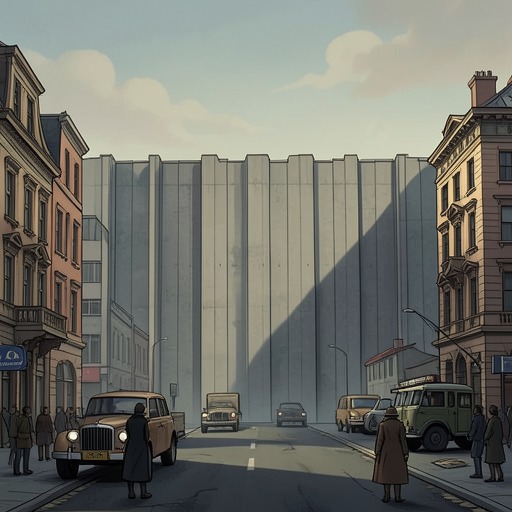
The Wall is both a physical structure and an ideological spectacle. At a Berlin checkpoint, Leamas watches the unattractive barrier of breeze blocks and barbed wire divide a ruined, unrestored city. Artificial light falls across the road and wall; the built environment seems reduced to a stark stage set, with the damage of war still visible on either side. The border does not merely separate political jurisdictions. It reshapes what movement, safety, and escape can mean.
The historical scale of that division emerges in the account of the Wall’s construction. Its sudden appearance leaves embassy staff discussing evacuation, while American and Soviet Bloc tanks face one another across a strip of road at Checkpoint Charlie. Their engines roar as if in preparation for battle, though the confrontation is also a display of mutual intimidation. British, American, French, and West German intelligence networks have failed to foresee the event; the new barrier exposes the limits of their knowledge as well as the vulnerability of the city.
The Wall changes the practical conditions of espionage. Agents caught on the wrong side of the new division must adapt, and some become stay-behind operatives communicating through hidden radios and prearranged secret writing. The intelligence trade grows more clandestine and perilous, while the presence of spies and competing allegiances makes the divided city harder to read. The line that separates East from West also separates what can be known, who can be reached, and which forms of contact remain possible.
Its continuing reinforcement gives the division a grim durability. The Wall is heightened and protected by mined strips and finely prepared ground, even as people attempt to climb it, break through it, dig beneath it, or fly over it. The rare success of escape becomes evidence of both the system’s coercive force and the courage needed to resist it. In the novel’s context, the Wall is not a static backdrop: it is an obstacle that determines action and makes the prospect of crossing a matter of life and death.
Intelligence, Evidence, and Deception
The Cold War’s contest is also conducted through information whose meaning is uncertain. Riemeck’s material includes minutes of the Praesidium, a proposed change in East Germany’s relationship with COMECON, and a detailed account of the East German intelligence service. Peters questions whether Riemeck could have obtained such a range of information alone. His doubt echoes Control’s earlier concern about Riemeck’s access, making the apparent success of one source into a clue that there may be a more senior collaborator.
That uncertainty becomes central to the argument over Operation Rolling Stone. Fiedler rejects the idea that Leamas’s disclosures are valuable simply because they are extensive: the accounts of the Berlin organization are accurate, but much of the material is already known or merely useful background. What matters is whether the details point to a spy within a department or at a particular level. Without a basis for narrowing the suspect pool, the information offers suspicion rather than a usable identification. The operation is therefore as much an exercise in interpreting patterns as in collecting secrets.
The handling of the file makes secrecy visible as a procedure. A limited-subscription label and caveat instruct anyone not authorized to possess the file to return it unopened to Banking Section. The rule is more than administrative decoration: access itself is controlled, and the circulation of information is restricted even within the world of intelligence. Yet the very precautions that protect a file also create traces that can be examined, challenged, and used in an investigation.
Financial records supply another kind of evidence. Leamas confirms that Control held samples of the false signatures he used to open accounts, and the later examination of a Copenhagen account links a deposit under the name Robert Lang to a withdrawal by the co-signatory one week later. Fiedler connects the timing with Mundt’s visit to Denmark under an alias. The account’s ten thousand dollars, the dates, and the movements associated with them turn apparently technical details into an argument about who has been using whom. The Helsinki account and a later clandestine journey to Finland extend the same pattern, while the absence of a bank reply from Helsinki remains an acknowledged gap rather than proof in itself.
Rival Methods and Moral Claims
Control describes the British service as defensive, insisting that disagreeable acts are undertaken so ordinary people can sleep safely. But he also concedes that the service sometimes does wicked things and warns against comparing one side’s ideals with the other side’s methods. The more exact comparison, he argues, is between methods and between ideals. He goes further: since the war, the methods of the opposing services have become much the same. The defense of a benevolent policy, in his account, cannot excuse a service from being less ruthless than its opponent.
This admission complicates the distinction between the two sides without erasing their political differences. Mundt is described as a practitioner of the Cold War, a man whose past and methods make him distasteful to Control; Leamas responds that the description could apply to them as well. The brief exchange refuses an easy moral separation. The novel’s conflict is not that every claim made by either side is identical, but that their competing systems of justification can produce comparable forms of secrecy and manipulation.
Leamas’s recruitment makes that moral ambiguity personal. When Kiever approaches him through the promise of paid work and foreign-bank payments, Leamas recognizes that his recent imprisonment, financial hardship, and resentment make him appear susceptible. He also understands that the offer is a gamble: people do not respond predictably to inducements, and even respectable figures may be driven toward treason by small, ordinary grievances. His calculations show the Cold War operating not only through grand political beliefs but through vulnerabilities that institutions can anticipate and exploit.
The later revelation that Leamas has been deceived gives the espionage contest its human cost. In the Tribunal, he abruptly understands the trick behind the case. The moment alters the meaning of the evidence that has been assembled and the assumptions he has relied on: the machinery of the operation has not simply exposed an enemy but has also positioned him within a design whose full purpose was withheld. The institutions’ capacity to control information becomes a means of controlling the people who act on it.
Borders, Escape, and Human Cost
The border crossing scenes show how political division governs even the smallest actions. When Leamas is taken across the sector boundary in a Mercedes, passage proceeds through coordination and timing: another car goes ahead, the barrier rises, and both vehicles cross. On the eastern side, new fortifications—observation towers and multiple runs of barbed wire—make the change of territory unmistakable. The crossing is easy in that moment because a planned operation has arranged it, a contrast that underscores how inaccessible the same border can be to someone trying to escape independently.
That contrast is established earlier in the fate of Karl Riemeck. At the checkpoint, he appears to have passed the document and customs checks and is approaching the remaining barrier when searchlights expose him. An East German sentry fires as Riemeck continues on his bicycle, and he falls beside it. For Leamas, watching from the checkpoint, the episode makes the border’s violence immediate; his later recollection of Karl’s omissions also connects political danger with the imperfect trust between an agent and his handler. The incident becomes a personal loss and a lesson in the risks that intelligence work leaves to its participants.
The planned attempt by Leamas and Liz to reach the Wall offers another measure of the danger. Their guide directs them toward a specific stretch of barrier near Pankow, where a small gap has been cut in the barbed wire, and tells them they will have only a short interval to climb. Searchlight timing and the route are matters of procedure, but that procedure cannot remove the fundamental peril of crossing. The Wall makes escape depend on a narrow opening, a brief opportunity, and the cooperation of people whose own safety is uncertain.
The novel’s treatment of escape also places individual acts against a longer political history. Those who succeed are few and are remembered for their bravery; their attempts anticipate, in the retrospective account, a broader challenge to East German rule. The Wall’s endurance and the stories of people who cross it hold opposing truths together: the border demonstrates the regime’s power to confine, while each escape shows that its authority is neither universally accepted nor beyond resistance. The Cold War thus becomes more than a contest between states. It is a struggle over movement, knowledge, and the value assigned to particular lives.